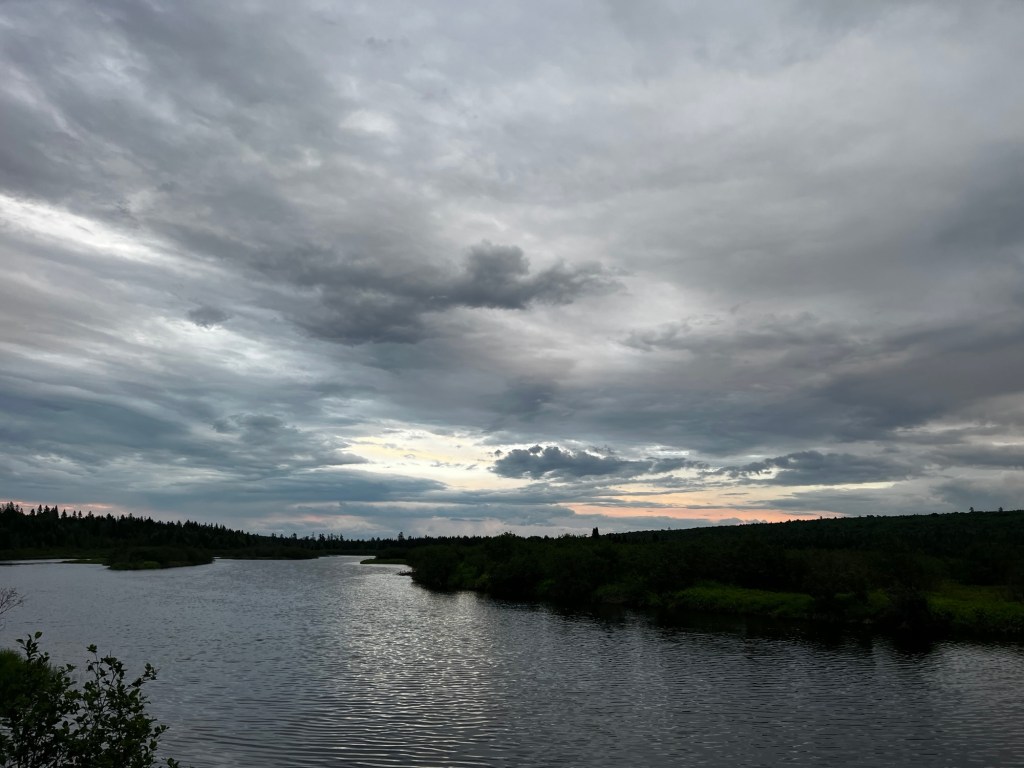
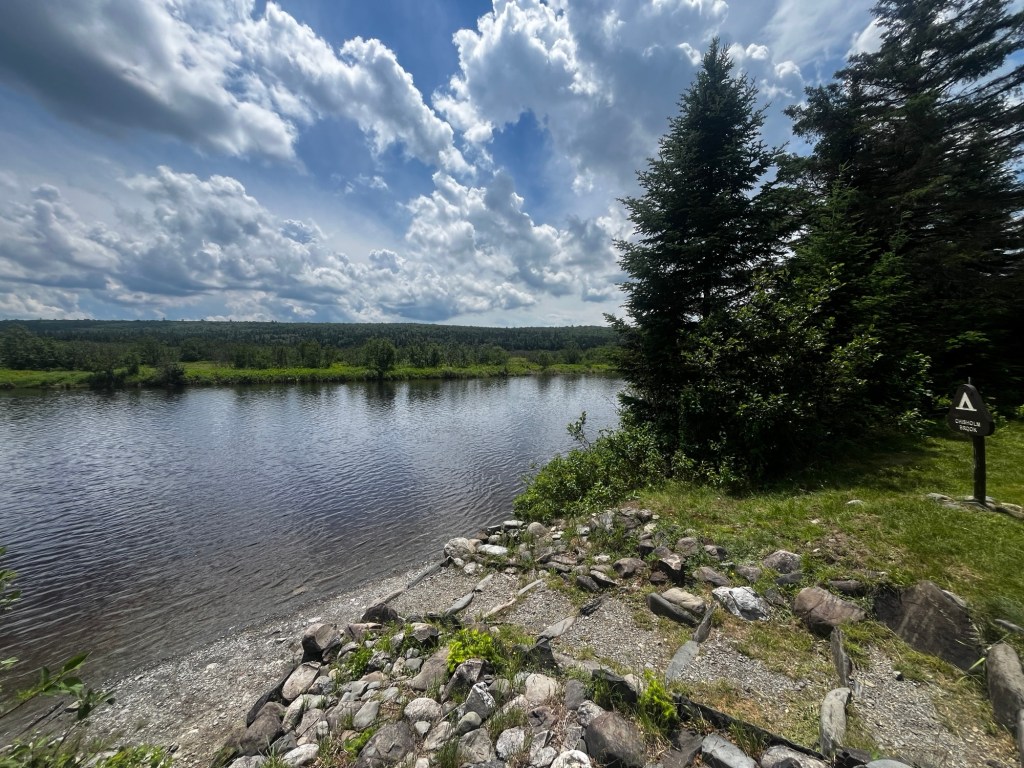
Tuesday morning, second full day on the river, and it did not look like the scene above (that was Monday afternoon), yet the rain had not started as promised either. Yet, there was a density to the air that spoke of the impending rain. The prior afternoon had been so beautiful and tranquil that we were due for a bout of wetness. Luckily, we were afforded the time in the morning to wake up, have breakfast, and fully break down the campsite before the first drops of water began falling on and around us. We were prepared though, we had heard that rain was coming and most if not all of us had our rain pants and rain jackets on, and with preparation comes a certain contentment, even with rain that grew to be steady and light throughout the morning, knowing that we would be generally dry as the day progressed. It never dumped buckets as we began our push across Lake Umsaskis, paddling for the lone peninsula, hazy in the distance of the misty rain, where Ledges campsite is located. We silently approached, and then passed by, graced with a few bald eagles perched lonely in the tops of their evergreens. The rain was calming, quiet, and peaceful as we rode through the narrows after Umsaskis on our way to Long Lake. We paddled and paddled, each boat digging in and pushing, knowing that each stroke brought us closer to lunch and closer to our stopping point for the day.
Sam’s was our lunch stop, a campsite along a gravely stretch of Long Lake and about two thirds of the way down. Upon watering a tree, I noticed some of the first signs of the old logging operations along the Allagash, litter from decades ago, old rusted beer cans of the variety that lives on solely in history, rusted metal oil cans, old glass bottles…..I would have carried some out, but the more I looked, the more I came to realize it was a Herculean task beyond any of our capabilities to make a true dent in, so I went back and had lunch, PB&J on a tortilla wrap. The scouts made brave concoctions that included mayonnaise, bbq sauce, PB&J and banana peppers, some even adding in nutella. We consulted our map, and saw that we were maybe an hour or two from our campsite for the day. Not bad paddling, steady and slow, but good progress being made, and with lunch coming to a close, the rain began to diminish, giving us a glimmer of hope that it might move on in the near future.
As we approached the end of Long Lake and it began to squeeze the water back into the river bed, I noticed what looked like a massive brown boulder at the edge of the water in the distance. As we paddled closer, the current beginning to tug at our canoes again, I saw the brown boulder move and realized I was watching a full grown moose standing waist deep eating grass fronds in the water. It would completely submerge its head to grab the grass and then soon after pull it up to masticate its meal while shaking water off its head and out of its big floppy ears. It glanced at us once or twice as we slowly and silently floated past, none of us willing to pull deeply on the paddles, letting the current sweep us slowly by this wonder of the north. Truth be told, before this trip, I had never seen a moose in the wild, and here I was, late on a rainy Tuesday morning gliding by one no more than 50 yards off our port side. That and the bald eagle swooping by made for a quintessential Maine moment. But as with all things, the moment and us glided by, and we commenced paddling the last bit to Long Lake Dam.
Pulling off to the right as this was also our first true portage of the trip, we got out and walked up to the campsite. The first cell, which the portage trail ran right through, had not been maintained in weeks and the grass was approaching a foot in height. The second cell was even more overgrown and with the scouts consulting briefly with our guide, our crew leader of the scouts just days ago realizing he had a deep fear of tics, decided not to camp there, make our short portage around Long Lake Dam, and continue on to the next campsite, well aware that other canoers had passed us and that we ran the possibility of some of those cells being taken. Yet, the scouts weren’t happy with where we were, so we pushed on. It took us only 2 trips to make the portage, one for the gear and one for the canoes. A short time later, we were back on the water and began to see small patches of blue visible through the slowly dissipating clouds. Yet the rain wasn’t done with us yet, a few sprinkles here and there as we paddled on, but we could tell its strength was waning and the sun would eventually win out the remainder of the day.
The more we paddled, the more the clouds broke up giving us hope. Yet, the next campsite, Cunliffe Island, was already taken when we came upon it, as well as the next closest as well, Sweeney Brook. These were both single cell campsites and with the size of our crew, we just wouldn’t be able to cram in or expect others to make room for us. We had little choice but to push on even farther, the hours ticking by as we now rowed our way towards dinner. The next push was a long one, but luckily one that was aided by the flow of the river, pulling us always northward towards the Canadian border. My arms began to ache, yet the scouts, as green to canoeing as the color of some of our canoes themselves, simply dug in and pushed on, the sun bringing levity to our moods, laughter echoing up and down the river as we passed the interminable wall of green on either side, trees pushed right to the edge of the river, letting us know we only had one way to go, downstream. Towards the end of our push, while we were still in good spirits, we were all aching to be on dry land, one canoe in particular, the last of the scout canoes, took to chatting more than paddling. They would dip their paddles, then chat, dip their paddles, then chat. All the while, with the distance growing between them and the next closest scout canoe, my canoe partner and I tried every motivation we could think of to get them to push just a little harder so we could get to the campsite sooner. Eventually we did make it, Round Pond and Inlet Campsite our final destination for the day. Rounding the final corner, we saw our lead party on dry land waving us in, a cell available for us to stay at.
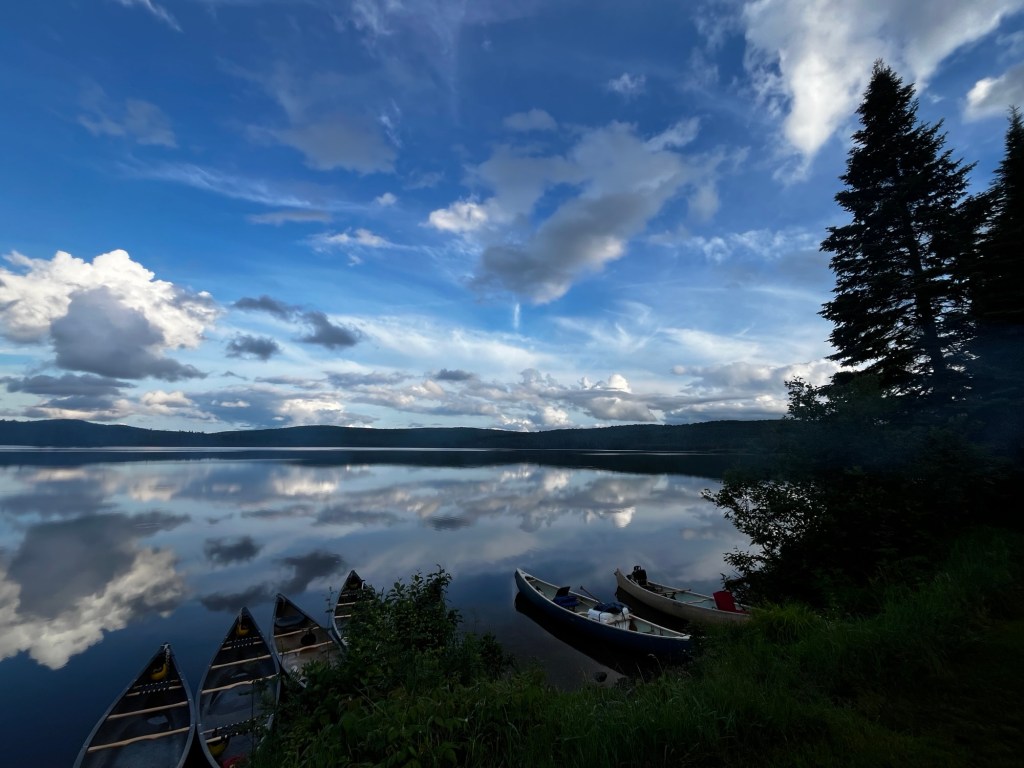
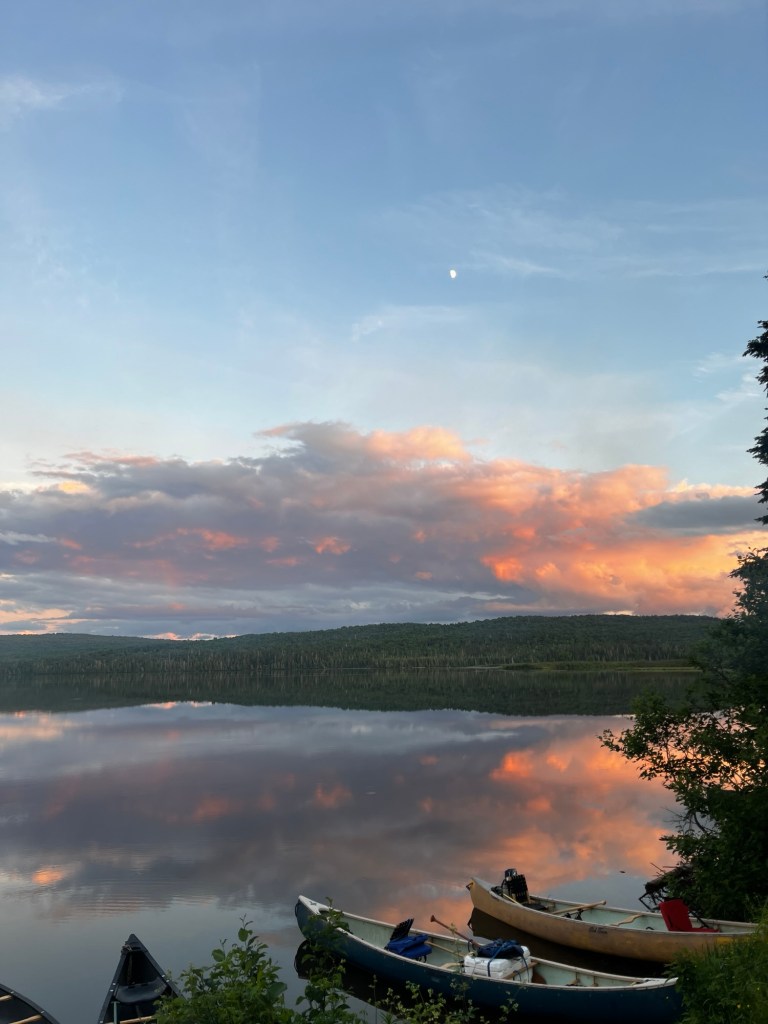
We were sharing the campsite with another party who had been paddling the Allagash every year for the past 30 years and they had all the gear to prove it. Massive rain fly, cook stoves, cooler, and backpacks of every style, dry bags, camp chairs, saws and axes….all transported in the bellies of the canoes they paddled. And then there was us, just enough supplies to get us by, simple and functional, the best part of being on dry land just before dinner was the lack of rain and a clearing sky. We unloaded, tied off our canoes securely and made camp. I walked off to clear my frustration at what turned out at the end of the day to be our longest of the week, 22 miles paddled down river, almost twice as long as we initially anticipated it to be, but it would give us one benefit which the scouts in their planning phase had originally talked about, a rest day in the middle of the week. With pushing so far in one day, we would have the luxury of hanging out at camp and hiking a fire tower trail the next day. So while our muscles may have ached, we knew we would be able to recover the next day. So with the sun painting a glorious landscape on the clouds as it set beyond the hills, we got ready to turn in and rest our weary limbs.


Leave a Reply